
Moon Water
An herbal ritual for the October moon
I have been making moon water for years, and it is probably one of the easiest rituals to add to a seasonal practice. You need a jar, water, a place to set it outside and, if you'd like, a few herbs.
That's really it.
There are plenty of rules floating around about moon water: which moon you're supposed to make it under, what each phase means, what kind of container to use, how long to leave it out, and what the water is supposedly “charged” with afterward. I don't think it needs to be that complicated.
For me, making moon water is mostly a way of stopping long enough to acknowledge the moon and where we are in its cycle. It gets me outside after dark. It makes me look up. And when I add herbs, it also becomes a way of bringing the plants I've been tending all season into the practice with me.
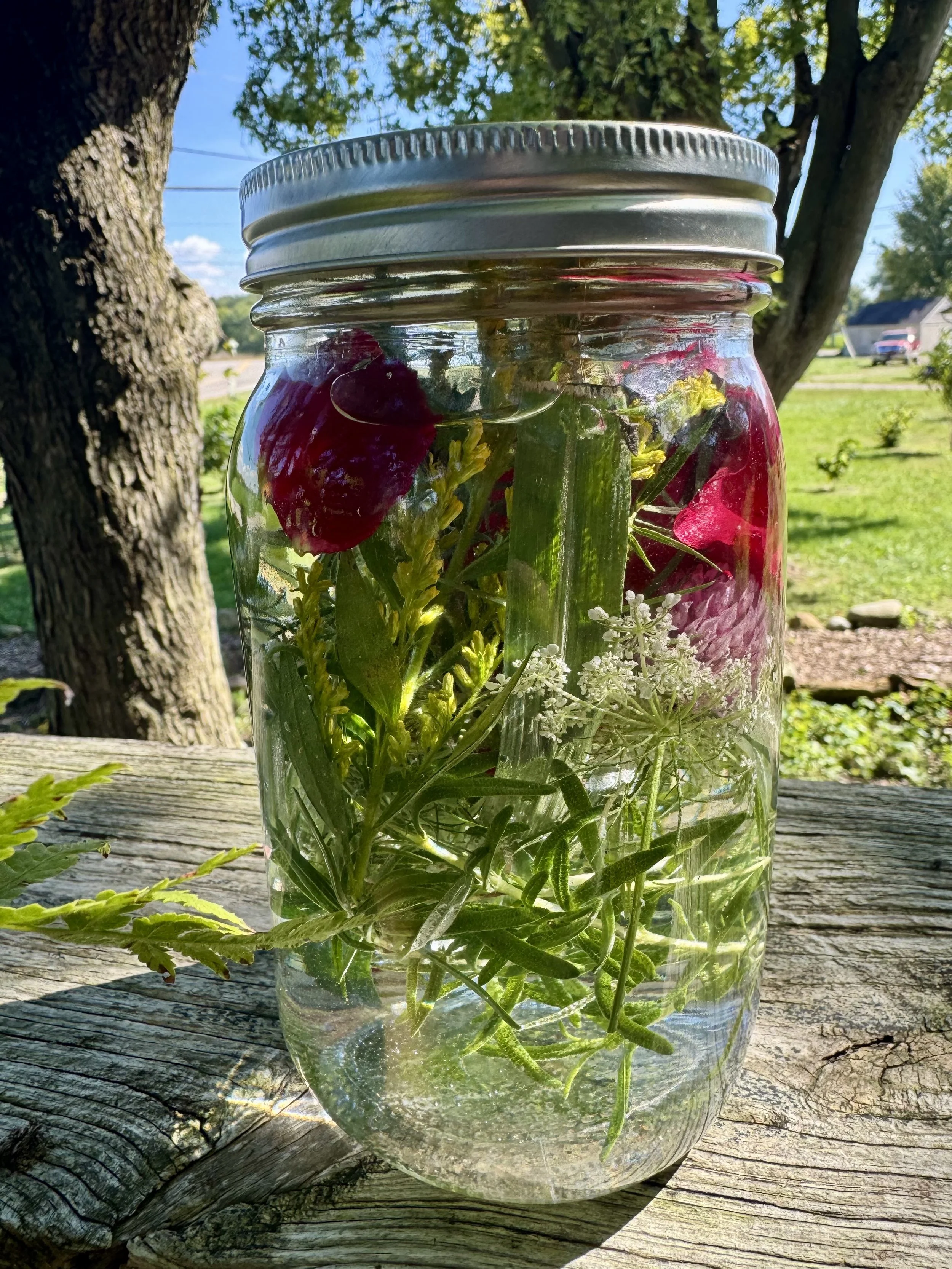
I chose these herbs to pull one last bit of the summer forward. I will be using this moon water in my home cleansing for the winter.
Choosing Your Herbs
Before you start looking up lists of magical herbal correspondences, look at what you actually have.
Walk through your garden. Open your apothecary. Look at the herbs hanging in the kitchen or the plants growing in pots around your house. What have you been working with lately? What did you grow this summer? Is there a plant that reminds you of someone or somewhere? Is there an herb that has simply become part of your life this year?
That is usually where I start.
For October, rosemary (Salvia rosmarinus) is an especially lovely choice. Rosemary has a long association with remembrance in European tradition and has historically appeared in funerary and commemorative customs. With so much of October's Cottage Year centered around memory, ancestors and what we carry forward, it fits naturally without needing to invent a new meaning for it.
You might also use rose (Rosa spp.), particularly if you have petals saved from your own garden, or thyme (Thymus vulgaris), lemon balm (Melissa officinalis), lavender (Lavandula angustifolia), or another familiar herb.
But don't feel like you need to choose the herb with the “correct” meaning.
Maybe your grandmother grew mint and its smell immediately makes you think of her. Use mint. Maybe you planted your first rosemary this year and somehow managed not to kill it. That seems worth commemorating. Maybe you have a jar of dried calendula you grew all summer and you simply want to use some of it.
The relationship you have with the plant can be part of its meaning.
Making Your Moon Water
Fill a clean glass jar with water and add a small amount of your chosen herb. You can use fresh or dried plant material. Put a lid on the jar and take it outside.
Then don't immediately go back inside.
Spend a few minutes out there. Look for the moon. Some nights it will be bright and impossible to miss. Other nights you'll find yourself standing under a completely cloudy sky with your jar of herbs wondering why you bothered.
It still counts.
Notice what October actually feels like where you live. Is it cold yet? Are insects still calling? Which trees have started dropping their leaves? Can you smell woodsmoke? Is your garden still hanging on, or did the first frost take most of it? The point isn't to interpret every little thing you notice. Just pay attention.
Leave your covered jar outside overnight and bring it back in the next morning.
Because we've added plant material and left it sitting in water for hours, I treat herbal moon water as a ritual preparation rather than something to drink. I also make it fresh and use it rather than keeping jars of old herb water lined up on a shelf indefinitely.
What Do You Do With It?
This is the fun part because there really isn't one answer.
Add some to a bath or foot soak, as long as the plants you've chosen are appropriate for your skin. Add it to a floor or threshold wash. Pour some into a bowl to have beside you while you journal. Use it to wash a meaningful object. Take it into the garden. If the ingredients are appropriate for the plant, use it to water something.
Or take it back outside and pour it onto the earth.
You made the water to mark a moment. It doesn't have to become another thing you need to keep.
Working With the Moon
You can make moon water during any phase of the moon. I actually like working that way better than waiting only for a full moon.
The phases can give you a loose framework if you want one. As the moon grows, you might think about something you're beginning or tending. At the full moon, take stock of where you are. As it wanes, consider what you're finished with or what has become too heavy to keep carrying. The dark moon can simply be quiet.
These are prompts, not instructions.
The moon doesn't know that you're supposed to be “manifesting abundance” on Tuesday. If the full moon arrives and you are exhausted and want to go to bed at 8:30, please go to bed.
Take It to Your Journal
When you set your jar outside, write down the date, the moon phase and the herb you chose.
Start with the plant.
Why did I choose this herb? Where did it come from? What memories do I have attached to it? What has my relationship with this plant been this year?
Then write down what you noticed outside. Not what you think it symbolizes. What was actually happening. The temperature, clouds, sounds, plants, animals, smells, changes in the garden.
And then, if you want to go a little deeper, turn toward some of the questions we're sitting with this October:
What am I carrying forward with me? What have I inherited that still feels meaningful? What doesn't? What traditions do I want to keep? What would I like to begin doing differently?
You may end up writing three pages. You may write two sentences and go back inside because it's cold.
Either one is a practice.
The point isn't to perform the ritual correctly. It's to spend a little time with the moon, with a plant you know, and with yourself—and perhaps notice something you wouldn't have noticed otherwise.
